NIVEA inspection guidance
Start with the NIVEA package format in your hand
A NIVEA Creme tin, a sunscreen bottle, a deodorant can and a hand-cream tube do not give you the same surfaces to inspect. Begin with the complete package rather than searching for a fixed position. On a metal tin, rotate the base under side light and look for shallow embossing or ink added separately from the printed artwork. On a tube, inspect the sealed crimp before the carton flap. On bottles and sun-care packs, check the base, shoulder and rear-label area. If an outer carton is present, keep it beside the container and compare both.
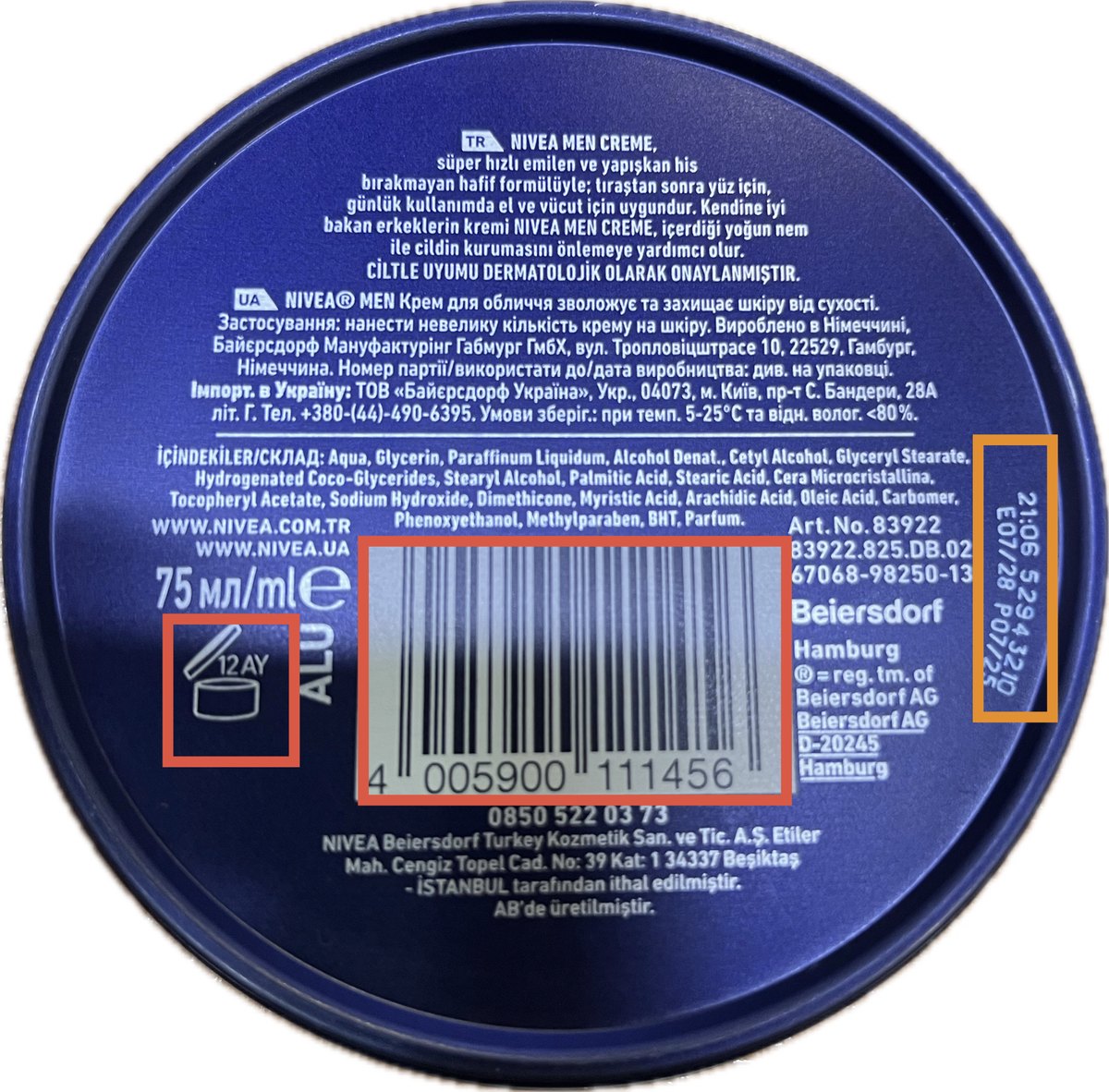
Photograph the whole panel before taking a close-up. The product name, size, barcode, printed date and open-jar symbol provide the context needed to decide which short marking belongs in the checker. A cropped string can hide a leading digit or make a date look like a lot code. These locations are an inspection order, not a promise that every NIVEA product or market uses one placement.
NIVEA package fact
What 52943210, P07/25, EAN 4005900111456 and 12M identify
The photographed NIVEA tin on this page carries several identifiers that answer different questions. The short production marking is 52943210. A separate printed field reads P07/25. The retail barcode carries EAN 4005900111456, while the open-jar symbol shows 12M. Enter the lot marking in the checker; do not enter the EAN, the printed date or the PAO value in its place.
For this observed package, the supported result for 52943210 aligns with July 2025, which is consistent with the separate P07/25 marking. That agreement is useful evidence for this exact tin. It does not establish that every NIVEA code has eight digits or that every package prints a matching month beside it. Beiersdorf sells face, body, lip, sun and deodorant products in many package formats and markets. Keep the code tied to the physical product shown instead of turning one example into a brand-wide cipher rule.
NIVEA package fact
Production timing, printed durability and PAO are separate
A supported lot result describes production timing. A date printed as minimum durability or expiry is package information for that product. PAO starts when the product is first opened. These three clocks should be read separately. If your NIVEA sunscreen, treatment or other exact pack prints a durability or expiry date, follow that field and its storage directions rather than calculating a new date from the batch result.
The EU Cosmetics Regulation treats the batch identifier, minimum-durability information and period-after-opening indication as separate label elements. It also explains why some cosmetics use a PAO indication instead of a minimum-durability date. Read the open-jar number exactly as printed: 12M on the photographed tin means the labelled period after opening for that product, not twelve months after manufacture and not a universal NIVEA rule. Do not copy the 12M value from this tin to a different cream, deodorant, lip product or sunscreen.
NIVEA inspection guidance
If the NIVEA code does not return a result
Compare the entry with the package one character at a time. Check whether O and 0, I and 1, or B and 8 were confused. Make sure you did not enter the long EAN below the barcode, a product reference, the printed P07/25 field or a PAO value such as 12M. For embossed tins, move a light across the base and take photographs from two angles; glare can erase one edge of a digit. For tubes, include the complete crimp because the first or last character may sit close to the seal.
A correctly copied marking may still use a production period or regional format that the current checker does not support. Keep the full-package photograph, retry only after confirming the characters, and use the photo-submission option below the location guide when the mark remains unreadable. Do not force the string into a familiar pattern or substitute another number merely to obtain a date.
NIVEA inspection guidance
Compare NIVEA Creme, sun care and deodorant like for like
Beiersdorf's official NIVEA profile describes a portfolio spanning face, lip and body care, sunscreen and deodorants. That range is why a useful inspection records the exact product family, format, size and market. Compare a metal Creme tin with the same tin presentation, a sunscreen bottle with the same protection product and a deodorant with the same container type. Packaging history can explain why an older blue tin differs from a current one, but it does not date an individual item.
For a practical record, retain front, rear and base photographs; the container and carton together; the lot marking; EAN or UPC; any printed date; the PAO symbol; product name and size; and the storage instructions. If the package has leaked, separated, changed unexpectedly or caused irritation, stop using it and follow the product label or contact the manufacturer. The checker adds production context where the marking is supported; the exact pack remains the source for expiry, PAO and storage decisions.